


Relaxing with a beer in Austria, May 2025
I tried a little experiment yesterday afternoon, and loaded a page from my Gilded Age research folder into my new Wordpress blog. The Obsidian version of this folder is a web of cross-referenced pages, which is what is needed, I think, to show this type of connected set of info. The page I loaded was a brief review of Anthony Sutton’s book, Wall Street and the Bolshevik Revolution. It wasn’t a long review, but it contained about a dozen links to other pages about people such as George Kennan and Trotsky, and institutions like J.P. Morgan & Co., Kuhn, Loeb and Co., and American International Corp.
Wordpress was designed as a blogging platform and it works very well for that purpose and also for some extended applications such as Pressbooks ebooks. HOWEVER, it is basically built around time-sensitive, sequential posts, not interlinked pages. You can’t even use Categories and Tabs with static pages, so I chose to make all the linked names in the Sutton review into posts. This sort-of violates my idea of a blogging, though, because by themselves these background pages aren’t really useful blog posts. Unless you’ve got a burning interest, today, in all the companies J.P. Morgan controlled in his day. But even then, his page is just a list, not a story.
I made about a dozen of these post-pages and linked them to each other more or less as I had in Obsidian (interestingly, Wordpress interpreted each link as a comment and asked me to moderate them all). This did result in an ability to jump from one page to another and, for example, follow Paul Warburg from Wells Fargo to the Federal Reserve. But it didn’t really give me the sense that I had been looking for, that I had created a web of connected information that was intuitive or easy to visualize. Worse, although I used Tags and Categories, when you go to the Category page, you just get a long scroll of all the posts that use that designation, in the order in which I made them. This is exactly the type of time-sensitivity vs. contextual organization I’m trying to get away from.
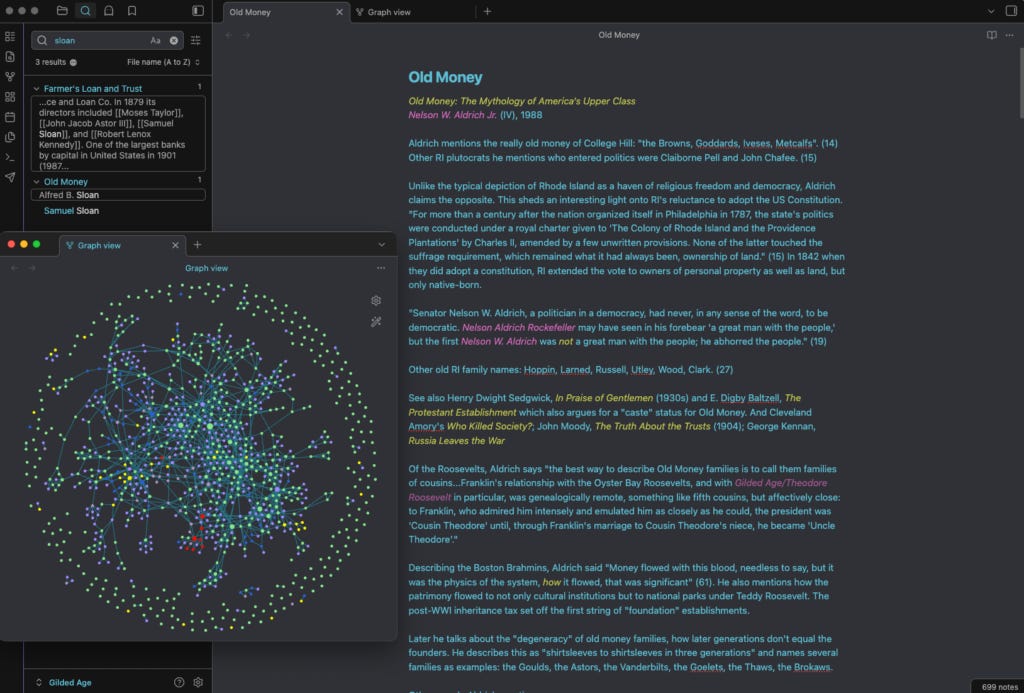
I suppose I could search for some type of tool or widget that would allow me to show the Category as something like an alphabetized list, or sort it by topics. But is even that what I’m really hoping for, here? I don’t think so. Something more like the a cross between Obsidian and Scrintal. Obsidian’s “graph view” is pretty random and Scrintal allows you to arrange linked “cards” on a virtual tabletop. But I don’t like the fact that the data I input into Scrintal lives on an EU server in Ireland. Maybe Heptabase? You can supposedly publish whiteboards. This is a bit more focused than publishing Obsidian vaults, since you can visually direct people a bit more than you can in Obsidian, where I tend to just stack pages with “Next” and “Back” buttons, plus some links in the body that take people to side-pages. Maybe I’ll try this same exercise on a Heptabase whiteboard and see if it feels more like what I’m trying to achieve with this web of info.
I watched a couple of Heptabase videos, made by the guy who developed the app and is CEO of the company. It seems like my shopping list of expectations is not quite standard. The CEO's videos focus on collecting and processing information (as they should); my interests at this point revolve more around sort-of simultaneously processing information and presenting it. There's nothing wrong with my existing Obsidian vault for most of what I'm doing. But maybe I could add a bit with Heptabase and gain some efficiency, maybe even insight. It might duplicate some of the work I've already done, building my notes in Obsidian. But reviewing those notes and doing a sort of "spring cleaning" as I reproduce some of them in Heptabase might not be a bad thing. I'll let you know.
I use Heptabase for my PKM. I wouldn’t say it’s for publishing. The whiteboard share feature is more for use with an internal team. There are some good options for publishing a digital garden from Obsidian. The best may be Quartz. https://quartz.jzhao.xyz There are many static site generators meant to build a published site from a set of markdown files, usually stored in GitHub. SilverBullet is another interesting project, as is Trilium Notes. I looked at all of these seriously for a digital garden project last year. If you want WordPress maybe look for a wiki plugin?