
OER Retrospective
Open Education

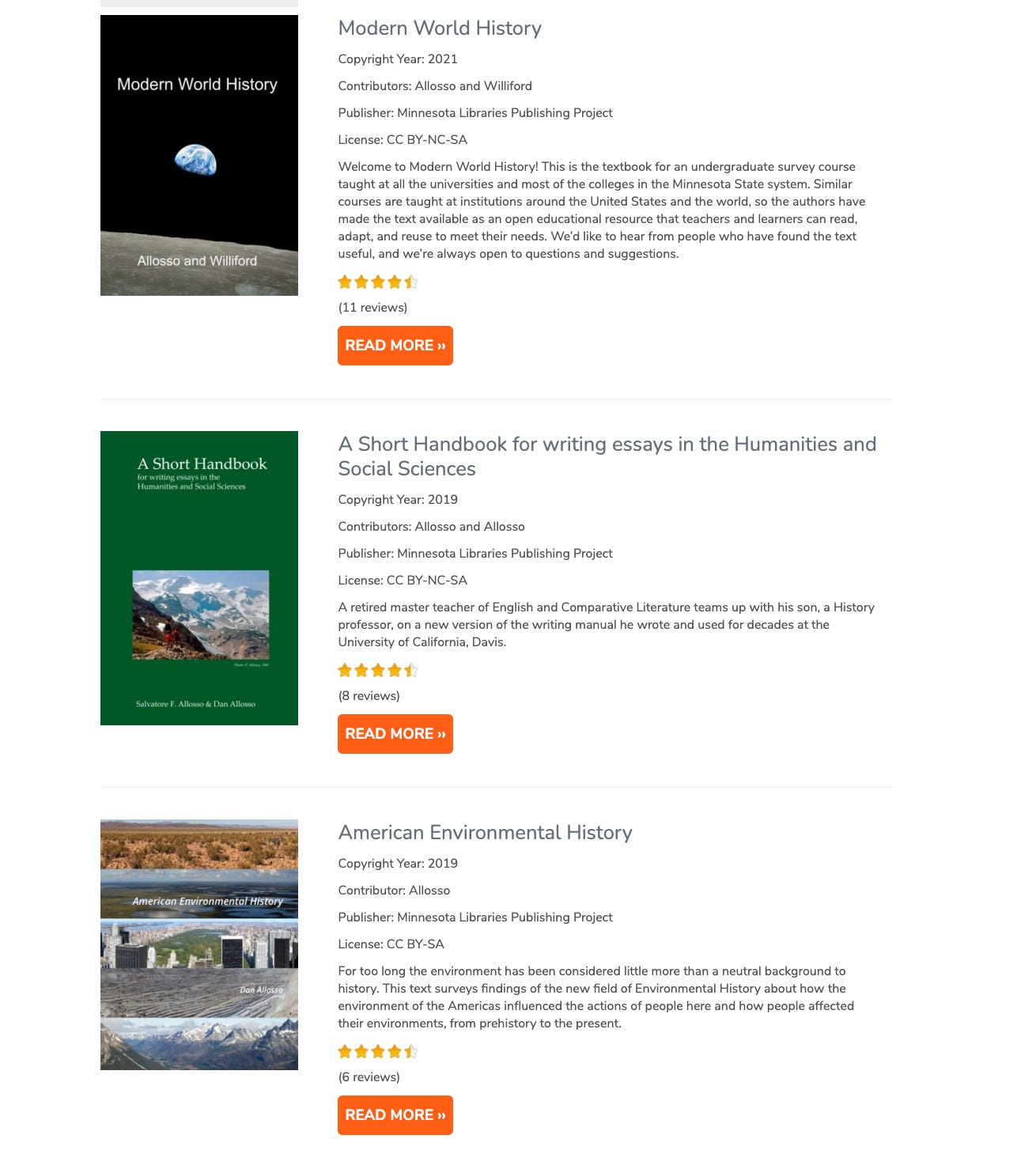
Some of my books on the Open Textbook Library.
This is a personal reflection on my experiences using and making Open Educational Resource (OER) content in higher ed between 2017 and 2025. The impressions I formed about the Open Education space are entirely based on my own experiences, so they are bound to be subjective, anecdotal, and related to the specific experiences I had. I don’t claim they represent a complete or correct view of the field, but I was asked by executives at the Minnesota State system office to write this retrospective. It’s late, but here it finally is.
College Textbooks are ridiculously expensive and often not that good.
This was the observation that got me interested in OER in the first place. When I went back to school for a PhD, I was already an author with an award-winning self-published novel under my belt. As an “ABD” grad student in history, I wrote my own textbook for an Environmental History class I taught online for the University of Massachusetts for a couple of years. I self-published this and sold it online.
A couple months after I completed my PhD, I was hired to teach several History courses at Bemidji State University (where I already lived). The gig, which later turned into a full-time job, was as an emergency replacement for a tenured professor who had been out on sabbatical but had become too ill to return to work. I was hired the week before the semester began, when she had finally admitted to the administration that she wasn’t returning. So the textbooks had already been purchased. The Modern World History textbook was $100 and the Primary Source reader that went with it was an additional $60. I used them the first semester but it was clear that students were not enjoying the experience of having to purchase these books. Some were High Schoolers taking PSEO courses, whose books were covered by the state. Many of the rest were struggling to make ends meet; holding down jobs that cut into their ability to study or skimping on food and other necessities to purchase on average $1,000 in textbooks each semester.
After a bit of poking around, I discovered with the aid of the Librarian assigned to the History program that there were open resources available. I began exploring this space and learning more about it. I then discovered that Karen, a psychology instructor at a college in the system, was running Learning Circles (LCs) for people who wanted to incorporate OER into their courses, redesign courses, or author OERs. I joined a ten-week session and converted my American Environmental History textbook into an OER, which I offered on the University of Minnesota’s Open Textbook Library. It has been extensively reviewed by six faculty readers throughout the US between 2019 and 2022, receiving a composite score of 4.5 out of 5 stars.
I attended the “E”ffordability Seminar at UW Stout in 2019, at which I presented with Karen and met Rajiv Jhangiani and Robin DeRosa, who were co-keynoting the event. In November 2019 I attended OE Global in Milan, where I also presented. I felt like I was meeting and interacting with people who were leading a worldwide revolution, and that I had something to contribute as an author and also possibly as an activist for this new modality.
Early-Career Overachievers
The emergency-replacement fixed-term gig under which I had originally begun teaching turned into a tenure-track assistant professorship at Bemidji State University. As a new member of the faculty team I was eager to make a good impression and demonstrate my value. I continued writing OER textbooks in Karen’s Learning Circles, completing a Modern World History textbook with a collaborator from Southwest State University, a writing handbook, a US History textbook, and a Primary Source anthology over the next few years. I got involved in the pilot program for the Z-Degree, supervising one of the first implementations at a community college in the Twin Cities and then writing a successful “exploratory grant” proposal when the opportunity was opened to four-year institutions. I worked with the BSU administration and Library Faculty and developed a plan to implement Z-Degrees in several programs including a general education BA degree that coordinated with the system’s transfer pathway from the two-year colleges to the universities.
When I was notified in late summer 2023 that my position had been “retrenched” and I would be laid off at the end of the 2023-24 academic year, my attitude toward OER began to change. I realized that activities that had seemed perfectly reasonable when I was a tenure-track assistant professor were much more problematic when I was facing unemployment. As a member of a faculty team focused on improving student outcomes and reducing barriers, it had made perfect sense for me to take a small stipend in a Learning Circle to write textbook content that would save students thousands of dollars. As an example, the Modern World History I donated to the Open Textbook Library has received 11 faculty reviews between 2021 and 2025, with an average rating of 4.5 of 5 stars. This suggests it is in use throughout the US. It has also been the foundation for at least one adaptation, by the Louisiana Library Network in 2022. In addition to my own classes, it has been adopted by at least two other professors in the system. If 150 Minnesota students per semester are saving $150 on textbooks they don’t have to purchase, that’s an annual savings of $45,000 per year. A pretty good deal, for the couple of thousand dollars the system spent on stipends for myself and my co-author.
However, the idea of putting a lot of effort into a book-writing project as a “second job” really only works when you have a dependable first job. There were other rewards for the effort, when I was on the tenure track. My Deans were extremely impressed with not only the quality of the output I was creating but my efforts on behalf of students. This was going to be the foundation of my tenure and promotion application. But of course, I was laid off and never wrote that application. I’m not sure how the logic that supported my efforts on OER authoring works, without job security. At some point, the system may need to address the issue of junior faculty realizing they have been investing in careers that they’re not actually going to have. At that point, it might begin to seem a bit like exploitation.
Too Much Centralization?
Another thing I’ve noticed, as Minnesota State’s relationship with OER has developed, has been a shift in emphasis from faculty-led to system-administered efforts. The initial OER Learning Circle model seems to have been inspired by a really organic combination of the system providing coordination and financing, and faculty providing direction and energy. I think this is probably due to the vision of several of the early OER advocates; most importantly my friend Karen. This model has worked very well over the nearly a decade that Karen has run these LCs as the primary vehicle for promoting OER in the system.
The key to the success of this model was that it was bottom-up, using faculty energy and ideas to remake courses and author content. More recently, an effort seems to have been undertaken to remake the OER LC model into something that can be more easily operated as a top-down process. There seems to be a lot of emphasis in this new model to standardize curriculum under the direction of Instructional Designers and to insert system priorities like Diversity and Equity in addition to Accessibility. While all these efforts can be justified as part of an effort to improve the OER output produced, I think they endanger the program.
As an analogy, when I was a new instructor in the Minnesota State system in 2017, I already had a couple of years experience teaching online courses, but I felt I was always interested in improving my courses. So I took a look at a review process called Quality Matters (QM). Its rigidity, at least as it was presented to me, was so oppressive that I “ran screaming from the room”. Again, I understand the logic behind QM and don’t disagree with its goals. But the way it was introduced to me suggested its efficacy and reach may be severely hampered by its format.
I think the system office is in danger of creating the same sort of effect with OER, based on increasing the administrative element over faculty self-direction. When I was newly-retrenched, I made some suggestions about how the system office could use me (a faculty member) as an ambassador to the faculty at colleges and universities throughout the system. I was invited to Mankato in the fall of 2023 and gave two talks about OER in support of a project spearheaded by the Library. This Mankato project seemed like an initiative with a lot of organic faculty energy behind it. The type of thing the system office should be encouraging and nurturing. Not trying to control.
Conclusions
I handed the Z-Degree exploration over to two senior faculty at Bemidji State and have recently heard that the Library Faculty person has returned from sabbatical and taken up the project again. It’s good, I think, that this is being coordinated by people who have more job security than I did. I’m not sure I would recommend to a junior faculty member that they devote too much energy to the “selfless” elements of the academic review process – but that’s a bigger issue than just OER work. However, it might be worthwhile for the system office to consider increasing stipends for this type of work, if the non-monetary institutional rewards continue to decrease in value.
On a more personal note, and partly to explain why it took me as long as it did to write this retrospective, I applied a while ago to be in another of Karen’s Learning Circles, to write a textbook for a World History 1 (Ancient and Medieval) course I’ve begun teaching. The first semester I taught it, I used a textbook; the same issues with quality, coverage, and cost impelled me to write my own. My application to the LC was denied (presumably because this retrospective report was late). I wrote the textbook anyway and let my students use the content for free. But I’m not going to donate it to Open Textbook Library. I’ll continue using it with my own students and will probably publish it as a course or a book and let it supplement my retirement income when I finish teaching in a couple of years. But it won’t be available to save hundreds of students in the system tens of thousands of dollars.
Administrators at the system office were certainly within their prerogatives to deny me access to the Learning Circle, and I have no hard feelings. But I think it’s worth examining, in light of the increase in system office centralization I mentioned earlier. Was this a good decision, in terms of improving student outcomes? Is the top-down imposition of standards and controls going to result in a flowering of creative energy and participation? At what point will it just not feel worth it, to the faculty the system is ultimately depending upon?
Does the OER encourage contributions from independent scholars or do they prefer that writers be formally affiliated with a university?