
Corporate Personhood
Readwise Review

One of today’s “Sunday Favorites” feed of fifteen highlights I had favorited in Readwise was this one from Noam Chomsky’s book, Who Rules the World?:
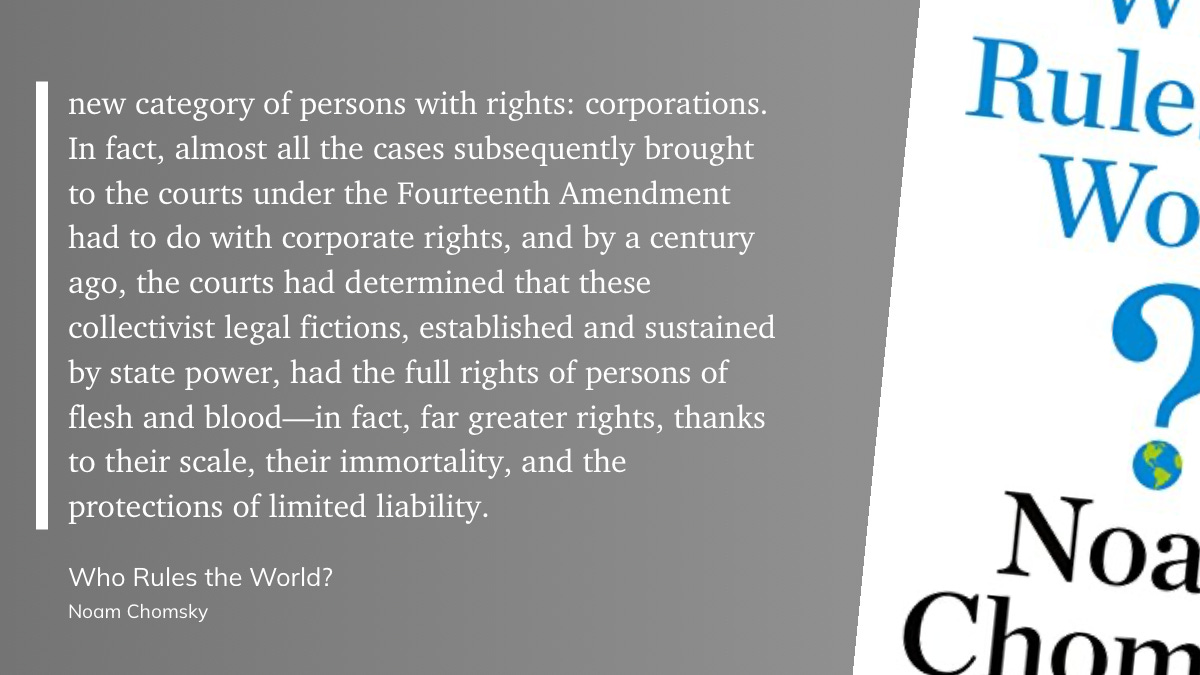
This is an important point, I think. The Fourteenth Amendment was written in July, 1868 to establish the citizenship of formerly enslaved people and enumerate some privileges, immunities, and legal protections that citizenship conferred. But the amendment is nearly two pages long and its language has been some of the most fought-over in American history. In contrast, the Thirteenth Amendment is a paragraph long and takes just half a page, including the signature block which bears Abraham Lincoln’s name. The whole Thirteenth Amendment says just this when it outlaws slavery:
Section 1. Neither slavery nor involuntary servitude, except as a punishment for crime whereof the party shall have been duly convicted, shall exist within the United States, or any place subject to their jurisdiction.
Section 2. Congress shall have power to enforce this article by appropriate legislation.
The Fifteenth Amendment is similarly brief. It establishes voting rights with these words:
Section 1. The right of citizens of the United States to vote shall not be denied or abridged by the United States or by any State on account of race, color, or previous condition of servitude.
Section 2. The Congress shall have power to enforce this article by appropriate legislation.
Unlike these two very specific adjustments to Constitutional Law, the Fourteenth Amendment meanders through five sections, each dealing with a slightly different topic, in ways that could be interpreted as overlapping in a confusing manner. Each of these clauses in the Amendment has been interpreted in ways that may or may not have been anticipated by the men who wrote them. For example, Section 1, the “Citizenship Clause”, has been the subject of both judicial, legislative, and executive challenges dealing with “birthright citizenship” and what actions a person might take that would disqualify themself from citizenship. The most recent challenge was Donald Trump’s January 2025 Executive Order denying citizenship to the children of illegal immigrants. Section 1 was designed to overrule the disastrous 1857 Supreme Court decision in Dred Scott v. Sanford, in which Chief Justice Roger Taney went on at length, describing why African Americans could never be considered qualified to become US citizens. Taney’s unnecessary opining in Dred Scott had actually been above and beyond the requirements of deciding the case, but had set a powerful precedent that extended way beyond the specific question at hand. In the same way, the Fourteenth Amendment’s repeated use of the term “any person” in the Citizenship, Due Process, and Equal Protection Clauses has notoriously created a legal precedent for corporate personhood.
It could be argued that it was less the fault of the Amendment’s authors that the ideas contained in the document were misinterpreted and perverted, and more the fault of subsequent Supreme Courts. Corporate personhood is a perfect example. Ironically, like Roger Taney’s opining in Dred Scott, it first raises its head in a “headnote” to a case not dealing with the issue. In remarks setting the scene for their decision in Santa Clara County v. Southern Pacific Railroad (1886), the court remarked, “The court does not wish to hear argument on the question whether the provision in the Fourteenth Amendment to the Constitution, which forbids a State to deny to any person within its jurisdiction the equal protection of the laws, applies to these corporations. We are all of the opinion that it does.” This statement, that the court were “all of the opinion” that “any person” applied to the fictional entities created by state charters, precluded any formal challenge by telegraphing the outcome. Thus, in a sneaky way, the court avoided having to actually produce a decision of an actual case to establish this principle. Talk about legislating from the bench!
Could this misunderstanding and misuse of the Fourteenth Amendment be corrected, if someone actually brought a case and the Supreme Court was forced to actually decide on the issue and justify it Constitutionally? Perhaps. Would that ever happen? It’s hard to imagine.
"Could this misunderstanding and misuse of the Fourteenth Amendment be corrected . . ."
Not if the Roberts Supreme Court has anything to do with it! -- [The Roberts Court Is Winning Its War on American Democracy | The New Republic](https://newrepublic.com/article/199773/roberts-court-winning-war-american-democracy). "The United States is less democratic, less self-governing, more dysfunctional, and more corrupt than it was 20 years ago, thanks in large part to the Supreme Court’s rulings."
And, not if the Rockbridge Network of Tech Bros has anything to do with it -- [J.D. Vance ally Chris Buskirk is planning MAGA’s post-Trump future - The Washington Post](https://www.washingtonpost.com/technology/2025/11/04/chris-buskirk-maga-vance-post-trump/) -- "Chris Buskirk put tech elites at the center of power in Trump’s Washington. His efforts are grounded in a controversial theory: An “aristocracy” is needed to move the country forward."
"In 2019, a small group of right-wing donors rented a resort outside the 100-person town of Rockbridge, Ohio, for a summit to secure the future of the MAGA movement. They aimed to turn a singular candidate — President Donald Trump — into an enduring political coalition, with a pipeline of voters, donors and candidates that would cement a radical transformation of the GOP." . . . "Convened by Silicon Valley billionaire Peter Thiel and JD Vance, then an investor who had written a best-selling memoir, the meeting included hedge fund heiress Rebekah Mercer, then-Fox News host Tucker Carlson and economist Oren Cass, . . ." "Today, Buskirk helms the Rockbridge Network, a secretive organization birthed out of the weekend gathering that has established itself as one of the most influential forces in GOP politics."
. . .
"Many innovative periods in history have been driven by such an aristocracy, Buskirk argues, a point he makes in his 2023 book, “America and the Art of the Possible.” “In the classic Greek sense,” the term isn’t pejorative, he says, but “a proper elite that takes care of the country and governs it well so that everyone prospers.”'